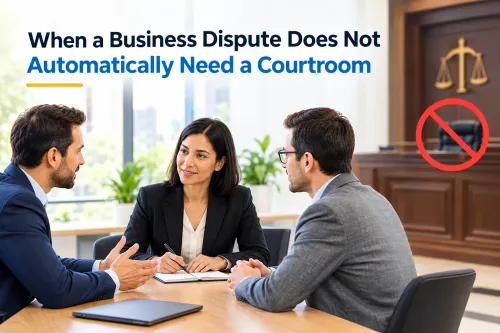



A supplier claims that ₹25 lakh remains unpaid. The customer responds that the goods failed to meet agreed quality standards and refuses to release the balance.
Emails become increasingly confrontational, operational communication breaks down, and both sides begin discussing legal action.
Before initiating Commercial Litigation, a business needs more than an immediate reaction. A structured assessment can help clarify what happened, what the contract provides, and which options may be relevant.
Start With the Documents
The legal position in a commercial dispute can depend significantly on available records. Businesses may need to organise documents such as:
Signed contracts and amendments
Purchase orders and invoices
Delivery and acceptance records
Quality or inspection reports
Emails and formal correspondence
Meeting records
Payment history
Notices
Relevant internal approvals
Arranging these records chronologically can help identify when the disagreement began and whether contractual procedures were followed.
Review the Contract Before Deciding the Forum
A commercial agreement may contain provisions concerning governing law, jurisdiction, arbitration, notice requirements, limitation of liability, payment obligations, termination, and dispute escalation.
These provisions can influence how a dispute proceeds.
For example, the existence of an arbitration clause may be relevant when determining the appropriate forum. Contractual requirements concerning how and where notices must be delivered may also require attention before formal steps are taken.
Consider the Commercial Objective
Not every dispute has the same desired outcome. Management may need to ask:
What outcome does the business require?
What evidence supports its position?
What does the contract require?
Is a negotiated settlement commercially acceptable?
Is urgent intervention necessary?
What would prolonged conflict mean operationally and financially?
The answers may influence whether negotiation, mediation, arbitration, or court proceedings are considered.
Legal Strategy Should Reflect Business Realities
The phrase Commercial Lawyers in Pune often appears when businesses research commercial disputes, but the underlying issue is broader than choosing a litigation route.
Disagreements involving suppliers, customers, contractors, shareholders, distributors, and service providers can involve different contractual and commercial considerations.
A useful first step is therefore understanding the evidence, contractual framework, available remedies, and intended business outcome.
Entering a dispute-resolution process with organized records and clearly identified objectives can support more informed decision-making as the matter develops.